Aerospace-Type Parts on 5-Axis Machines in Vietnam: Where the Line Is Today
Buyers ask whether Vietnam can make aerospace parts. The honest answer is that it depends on which parts. Some work is realistic today, some needs a long qualification and some should stay with established aerospace suppliers. This guide draws the line plainly, so you do not spend months finding out.
We are a matching service. We own no machines and name no shop. We do not claim any approval, certificate or qualification for any shop. All claims should be checked with the issuer.
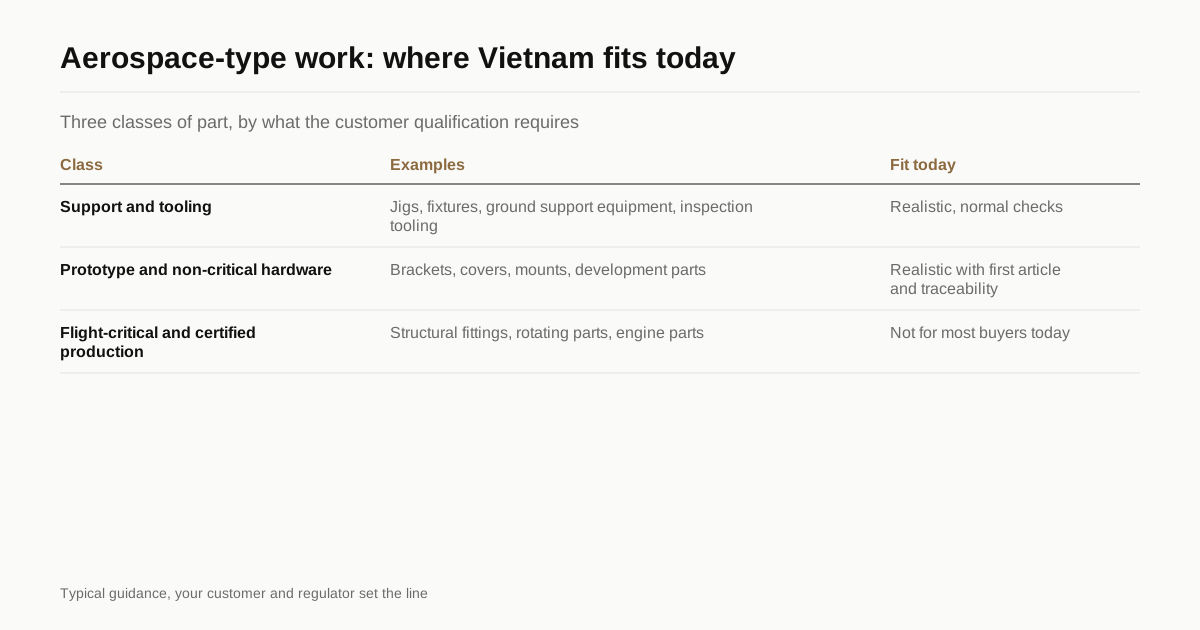
Three classes of work
| Class | Examples | Realistic in Vietnam today? |
|---|---|---|
| Support and tooling | Jigs, fixtures, ground support equipment, test rigs, inspection tooling | Yes, with normal checks |
| Prototype and non-critical hardware | Brackets, covers, mounts, enclosures, development parts | Yes, with first article and traceability |
| Flight-critical and certified production | Structural fittings, rotating parts, engine parts, certified assemblies | Not for most buyers today |
The line between the second and third class is set by your customer and your regulator, not by us. If your part is flight-critical, your customer’s approved supplier list and process approvals decide who can make it.
What aerospace work asks for
Aerospace programmes ask for things that general machining does not.
- Approved quality system. Buyers often require a certificate to an aerospace quality standard. Ask for the certificate, check scope and expiry with the issuer.
- Special-process approvals. Heat treatment, anodising, plating, NDT and welding may each need an approval held by the process provider.
- Full traceability. From mill heat number through each operation to the finished part.
- First article inspection. Often to a standard such as AS9102, with a defined form.
- Configuration control. Drawing revisions controlled and recorded.
- Counterfeit prevention. Material and component sources documented.
Many of these are about systems, not machine capability. A shop with a good 5-axis machine can still lack the system. Ask what exists and ask to see it.
Materials
Typical aerospace-type materials are 7075 and 2024 aluminium, Ti-6Al-4V titanium, 17-4 PH and 15-5 PH stainless steels and nickel alloys such as Inconel 718. Each has sourcing and certificate points covered in our guides: aluminium supply, titanium bar sourcing, stainless condition and passivation and Inconel work. The material certificate and traceability are the base of any aerospace-type job; see mill certificates.
What 5-axis gives aerospace-type parts
Aerospace parts are often thin-walled, pocketed and angled. A 5-axis machine cuts many faces in one clamping, which holds relationships and lowers the chance of error from re-clamping. Simultaneous work appears on blades, impellers, blisks and contoured structural surfaces. Indexed 3+2 work covers most brackets and housings. Ask the shop which process your part needs and use the capability check to verify. Our guide to impellers and pump parts explains the simultaneous class.
Thin walls and distortion
Aerospace parts remove a large share of the block, leaving thin webs. Residual stress and cutting force can warp them. Shops control this with stress-relieved stock, balanced cuts and rest periods. Ask for a similar thin-walled part the shop has made and its measured flatness.
Special processes
Heat treatment, anodising, chemical conversion coating, penetrant inspection and plating are usually outsourced. Aerospace customers often need these done by an approved processor, with a certificate for each lot. Ask who the processor is, what approval they hold and what record you receive. Do not assume. See finishing for 5-axis parts for how process steps affect tolerance.
Export control and compliance
Many aerospace parts, technical data and manufacturing know-how are controlled in the country of origin of the design and sometimes in the country of manufacture. Sending a drawing to a foreign shop can itself be an export. Classification depends on the part, the material and the end use, and rules differ by country and change over time. Check with your compliance team and customs broker before you request quotes. We do not give legal advice and we do not assume a part is free of controls. Keep civil, commercial applications distinct from controlled ones in your RFQ.
A realistic way to start
If you are testing Vietnam for aerospace-type work, start with a part that has low risk and high learning value:
- A fixture or inspection tool for your own use.
- A non-critical bracket or cover with a full drawing.
- A prototype lot with first article inspection and a full document pack.
Review the results against your own requirements before you widen the scope. Our guide to first article inspection lists what a useful report shows. Moving from a first trial to a repeat supplier is a matter of months of evidence, not a single order.
What a trial order should come back with
Treat the first aerospace-type order as an audit of the shop as much as a purchase. A complete return package has the parts and five records that you can check without visiting.
- Material certificate for each lot used, with the heat number written on the traveller.
- First article report with a ballooned drawing and measured values for every balloon.
- Process records for heat treatment, anodising or any other outsourced step, each naming the processor.
- Operator or programme record showing the drawing revision the parts were cut to.
- Packing record with photographs of how the parts were protected.
If a shop cannot assemble this package on a simple bracket, it will not manage it on a harder part. If it can, you have evidence to extend the work step by step.
Questions to ask a shop that says it does aerospace
Many shop profiles mention aerospace. A few direct questions separate real experience from marketing.
- Which aerospace parts did you make in the last two years, and for what class of customer?
- Which materials and special processes did those parts use, and who performed the processes?
- How do you control drawing revisions and how do you record which revision a lot was made to?
- What happens when a part is found out of tolerance after delivery? Describe the last case.
- Can a customer auditor visit, and has one done so?
Short, specific answers with part types and materials are a good sign. Answers that repeat the word “aerospace” without a part or a process are not. We pass your answers on to you without editing them, so you see what we see.
Why we say no sometimes
We decline part classes that do not fit, and we say so in the first reply. A flight-critical rotating part sent to a shop with no approval history wastes your time and the shop’s time, and it can delay a programme. A short, honest reply within 24 business hours is more useful than a quote that later falls apart on qualification.
What to put in the RFQ
- Part class: tooling, non-critical or other, so we can decline what does not fit.
- Material by standard and condition, with certificate type.
- Traceability and marking requirements.
- Special processes and who must perform them.
- First article inspection and report format.
- Any compliance requirement from your own side.
See also: AS9100 and Vietnam 5-axis machine shops, how to check a certificate and what to ask for when a shop has none.
Send the drawing and we will tell you whether the part fits a Vietnam shop today. If it does, we pass it to up to three shops with a reply within 24 business hours.
Questions
Can Vietnam shops make flight-critical aerospace parts?
For most buyers, not today. Flight-critical and certified production parts need approved processes, special-process approvals, full traceability and customer qualification that takes years. Vietnam shops are better matched to tooling, ground support equipment, non-critical brackets and prototype work.
Do Vietnam shops hold AS9100?
We do not claim any certification for any shop. Some shops may hold a quality system certificate, and you should ask for the certificate and check its scope and validity with the issuing body. Do not rely on a logo on a website.
What material do aerospace-type parts use?
Aluminium 7075 and 2024, titanium Ti-6Al-4V, stainless steels such as 17-4 PH and nickel alloys such as Inconel 718 are typical. Each needs a mill certificate with traceability. Our guides on these materials cover sourcing and checks.
Are there export rules for aerospace parts?
Yes, for many parts and in many countries. Classification depends on the part, the alloy and the end use. Check with your own compliance team and customs broker before you send drawings or place an order.
Have a part rather than a question?
Send the drawing and we match it with up to 3 Vietnam shops that run this kind of work. We reply within 24 business hours.