Impellers and Pump Parts on 5-Axis Machines in Vietnam: Open, Closed and What Needs Simultaneous Work
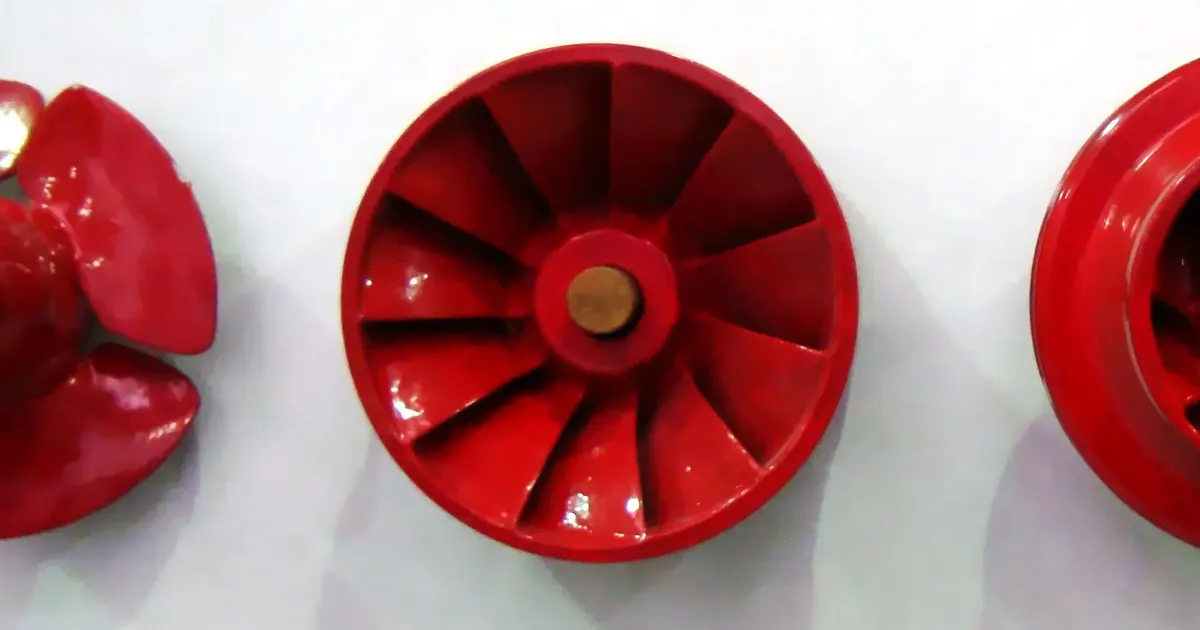
Impellers are the textbook reason for simultaneous 5-axis machining. A curved blade cannot be cut well from a fixed angle. They are also a stress test for a shop’s CAM, tooling and fixturing. This guide covers the impeller types, the process behind each, materials and what to put in the RFQ for Vietnam shops.
We are a matching service. We own no machines and name no shop. The figures are typical and depend on design.
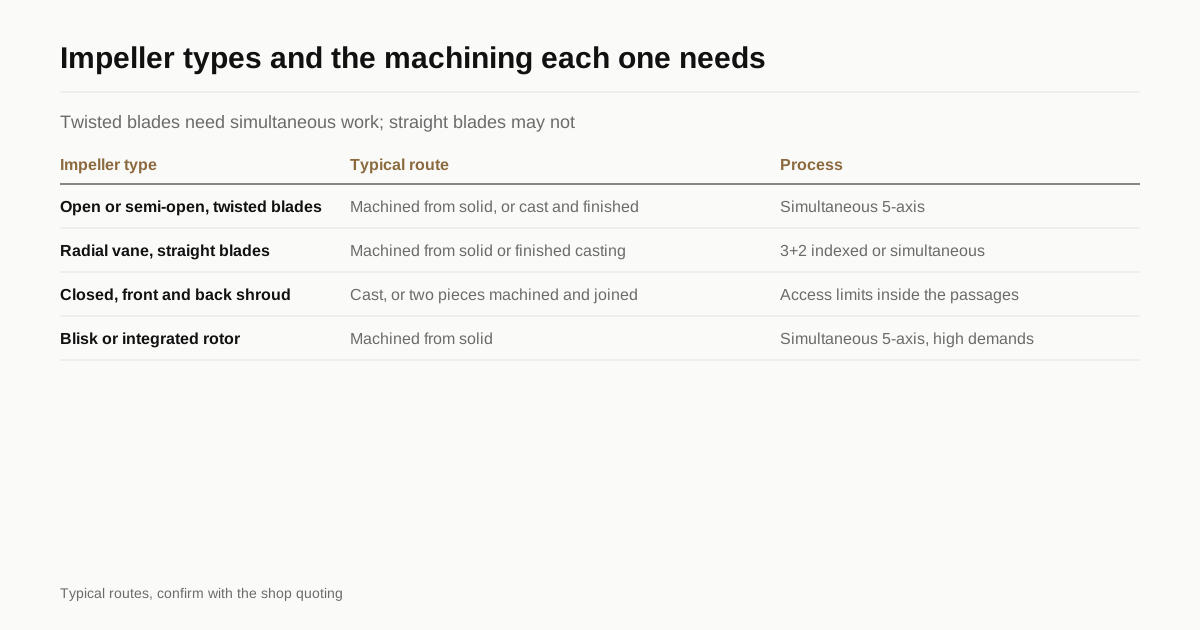
Impeller types and the machining each needs
| Type | Description | Typical process |
|---|---|---|
| Open impeller | Blades fixed to a hub, no front cover | Simultaneous 5-axis from solid, or cast and finished |
| Semi-open impeller | Blades with a back plate, no front cover | Simultaneous 5-axis from solid, or cast and finished |
| Closed impeller | Blades between front and back shrouds | Cast, or two-piece machined and joined; hard to reach inside |
| Radial vane impeller | Straight blades | 3+2 indexed or simultaneous, depending on geometry |
| Blisk or integrated rotor | Blades machined on the disk | Simultaneous 5-axis, high demands |
An open impeller with twisted blades is the typical simultaneous job. Indexed 3+2 work only suits straight or slightly curved blades where the tool can reach all surfaces from fixed angles. A shop that advertises 5-axis but runs only indexed work cannot do the first class. Our capability check guide shows how to separate the two.
What makes impellers hard
Tool access. Blades are close together, and the tool must clear the neighbouring blade and the hub. Tools are long and slender, often tapered, and deflect.
Blade thickness. Thin trailing edges bend under cutting force and vibrate.
Surface quality. Cusps and scallops on the blade surface reduce efficiency. Fine step-over and constant tool engagement are needed.
Collision checks. The tool, holder and spindle nose can strike a blade or the hub. Full machine simulation is needed; see CAM at Vietnam 5-axis shops.
Cycle time. Long, since many passes are needed. A single impeller can take hours.
Materials
| Material | Typical use | Notes |
|---|---|---|
| Aluminium 6061 or 7075 | Fans, blowers, prototypes | Fast to cut, watch thin blades |
| Stainless 316L, 17-4 PH, duplex | Chemical and process pumps | Slower, tool wear. See stainless machining |
| Bronze | Seawater and general pumps | Good machinability, often cast |
| Titanium | Aerospace, corrosive service | Slow, high cost. See titanium sourcing |
| Nickel alloys | Hot or aggressive service | Narrow pool. See Inconel |
Material certificates and traceability apply as for any job; see mill certificates.
Machining from solid or finishing castings
Pump makers usually cast impellers and finish-machine them. Machining from solid is chosen when volume is low, the alloy is not castable in a practical way, lead time is short or the design is still changing. For machined impellers, material cost and cycle time dominate the price. A casting adds pattern cost and lead time but cuts machine hours. Ask the shop to quote both routes and show the break-even.
Cast blanks need machining allowance and a datum strategy, since cast surfaces vary. For finish-machining castings, ask how the shop locates the casting and how it checks wall thickness.
Balancing
An impeller spins, so unbalance causes vibration, noise and bearing wear. Balance is specified by a grade under ISO 21940-11 or by a residual unbalance value at a stated speed. Machining produces symmetric parts only if the stock is uniform and the cut is symmetric, so most impellers are balanced after machining, with material removed from non-critical areas. State the grade, the speed and the allowed correction zones. Ask whether the shop balances in-house or outsources, and what record you receive.
Tolerances and inspection
Typical checks on an impeller include bore diameter and fit, hub face runout, blade thickness at defined sections, blade profile and outside diameter. Blade profile is measured with a CMM scan or an optical scanner and compared with the model. Ask for a deviation map in the first article, and specify the tolerance on the profile. Our guide to tolerances Vietnam 5-axis shops hold covers realistic bands, and first article inspection shows what the report should include.
Pump parts beyond the impeller
Other pump parts also fit 5-axis machines:
- Volutes and casings. Complex internal passages, sealing faces and bolt patterns.
- Diffusers and guide vanes. Blade-like features similar to impellers.
- Wear rings and sleeves. Mostly turned, with some milling.
- Seal chambers and covers. Faces and bores with tight positions.
Casings are often large and need big machines. Ask for the maximum envelope and part weight.
Finishing and protection
Impellers may be polished, passivated, coated or plated. Smooth surfaces improve efficiency and resist fouling. Coatings add thickness, so state the final dimensions. Pack impellers so blades do not touch anything; use foam cut to the shape or individual crates. See export packing for protection against humidity and damage.
Common mistakes
- Sending a 2D drawing without the blade model. The blade surface is defined by the 3D model, and a drawing alone leaves the shape to interpretation.
- Not stating the rotation direction and the datum for balance. The shop needs both to plan correction zones.
- Requiring a polish that removes the profile. Hand polishing changes blade shape. State what is allowed.
- Ignoring material cost. On impellers in stainless, titanium or nickel alloy, a scrapped blank is a large loss. Ask the shop how it protects the programme with proving cuts in softer material.
- Choosing a shop by machine alone. The CAM module and the programmer matter as much as the head and table.
A sensible first order
For a first impeller job, ask for one piece in the final material, plus one proving piece in aluminium or plastic if the geometry is new to the shop. The proving piece checks tool access, collision clearance and programme logic at low cost. After that, compare the deviation map of the first piece with your tolerance and decide on the batch.
Applications beyond pumps
The same machining logic applies to fans, blowers, turbocharger-style wheels, mixers and small turbines. Each has its own balance, speed and material questions, but the process questions are the same: simultaneous or indexed, what tool reach is needed, how thin the blade can be and how the part is measured. If your part is not a pump impeller, describe the application in the RFQ and we will match it on the process.
What to put in the RFQ
- Impeller type, blade count and the 3D model.
- Material, form and certificate type.
- Route: from solid, or finish-machining a casting you supply.
- Balance grade, speed and correction zones.
- Surface finish and where it applies.
- Blade profile tolerance and inspection method.
- Quantity and expected repeat orders.
Send the drawing with the 3D model and the balance requirement and we will tell you whether the part needs simultaneous work, then match it to up to three shops, with a reply within 24 business hours.
Questions
Do impellers need simultaneous 5-axis machining?
Open and semi-open impellers with twisted blades generally do, because the tool must stay close to normal to a changing blade surface. Simple radial vane impellers can sometimes be cut with 3+2 indexed work. Closed impellers add access problems and are often made in two pieces or cast and finished.
Is machining from solid better than casting?
For prototypes, small batches and special alloys, machining from solid is faster and avoids tooling cost. For larger volumes, castings finished by machining are usually cheaper. Ask the shop for both options and the break-even volume.
How is balance specified?
By a balance quality grade under ISO 21940-11, which replaced ISO 1940-1, or by a residual unbalance value. Pump impellers are commonly balanced to around grade G6.3 and finer for high speed. State the grade, the speed and the balancing method on the drawing.
What surface finish do impellers need?
Smooth blade surfaces improve efficiency and reduce cavitation damage and fouling. Ra 1.6 microns is common and Ra 0.8 is possible with fine finishing passes. State Ra and where it applies, and whether hand polishing is acceptable.
Have a part rather than a question?
Send the drawing and we match it with up to 3 Vietnam shops that run this kind of work. We reply within 24 business hours.