Inconel and Superalloy Parts on 5-Axis Machines in Vietnam: A Narrow Pool of Shops

Inconel and related nickel alloys are chosen for strength at high temperature and for corrosion resistance. They are also among the hardest common materials to cut. A Vietnam shop that runs aluminium well may struggle on the first nickel alloy job. This guide covers who the realistic suppliers are and what to ask before you send the drawing.
We are a matching service. We own no machines and name no shop. We do not claim that any shop can run these alloys; we ask for evidence.
The alloys you will see
| Alloy | Common designation | Typical standard | Notes |
|---|---|---|---|
| Inconel 718 | UNS N07718 | AMS 5662 and 5663 for bar | Aged to high strength, most common request |
| Inconel 625 | UNS N06625 | AMS 5666 for bar | Corrosion and fatigue resistance, solution strengthened |
| Hastelloy C-276 | UNS N10276 | ASTM B574 for bar | Chemical process parts |
| Waspaloy | UNS N07001 | AMS 5706 | Hot section parts |
| Monel 400 | UNS N04400 | ASTM B164 | Marine and chemical, easier than 718 |
Inconel, Hastelloy, Monel and Waspaloy are trade names of their owners. Use the UNS number or the standard on your drawing so a shop can quote against the right material.
Why these alloys are hard to cut
- Work hardening. The surface hardens under the tool. A tool that rubs for a moment makes the next pass harder.
- Low thermal conductivity. Heat stays in the cutting zone and at the tool edge.
- High strength at temperature. Cutting forces are high and tools soften before the metal does.
- Abrasive carbides. Hard particles wear tool edges.
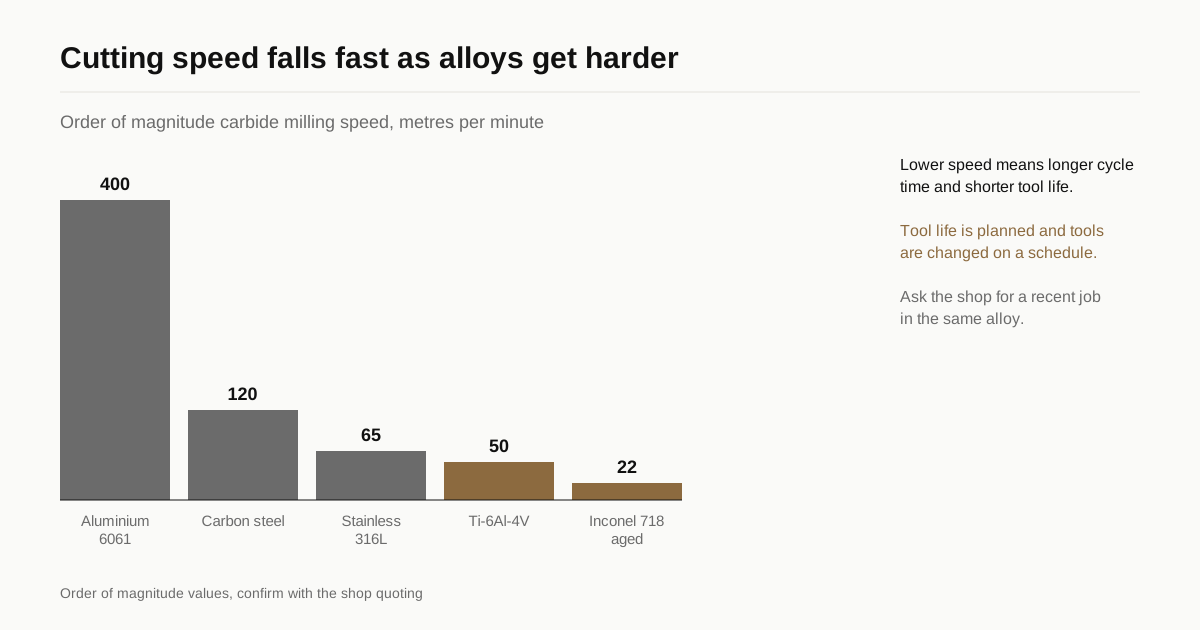
The result is short tool life, low cutting speeds and long cycle times. The chart shows an order-of-magnitude comparison of typical carbide milling speeds, from aluminium down to aged 718.
What a capable shop does
A shop that handles nickel alloys has habits that show quickly in conversation.
- Rigid machines. Heavy construction and good spindle torque at low speed.
- High-pressure coolant aimed through the tool, to break chips and carry heat away.
- Sharp tools, changed on schedule. Tool life is planned, with tools replaced before failure.
- Steady engagement. Toolpaths that avoid sudden loads and dwell. This is a CAM question; see our note on CAM at Vietnam 5-axis shops.
- Machining order. For 718, rough and semi-finish in the solution-annealed state, then age, then finish critical features. State the condition on the drawing.
- Careful inspection. Parts measured after ageing and after any coating.
Ask the shop to tell you the last Inconel job in a few lines: part, alloy, cycle time, tool life. A shop that has done it will answer easily.
Five-axis, indexed or simultaneous
Five-axis machines help with nickel alloys because the tool can reach deep features with short stick-out, and constant engagement strategies protect edges. For parts with features on several faces, 3+2 indexed work with short rigid tools is usually the safer choice. For blisks, impellers and blended surfaces, simultaneous work is needed and the programming demands rise. Our guide to impellers and pump parts covers that class. Ask which process the shop will use.
Material sourcing and traceability
Nickel alloy bar and plate are imported. Lead times can be several weeks, and cost per kilogram is high, so wasted blanks hurt. Ask for the producer’s mill certificate with chemistry and mechanical properties, and for the heat number on every blank. For these alloys, a wrong grade is a serious risk, so positive material identification at receiving is common. See our guide to mill certificates for what to check. Specialty-metal requirements in some customer contracts include country of melt, so state that early.
Heat treatment and process records
Ageing of 718 is a controlled furnace cycle with temperature records. Ask who performs it and what record you receive. Shops usually outsource it. Heat treatment affects size and distortion, so agree which dimensions apply after it. Non-destructive testing, such as penetrant inspection, may be required for critical parts. State it in the RFQ and ask who does it.
Where to be cautious
- First-time shops. A shop with no nickel experience may quote low and fail on tool life.
- Large or thin-walled parts. Distortion after ageing is hard to manage.
- Safety-critical rotating parts. These need a documented process, material traceability and inspection that many shops cannot yet support. Our piece on aerospace 5-axis machining in Vietnam describes what is realistic today.
- Controlled applications. Check export rules with your own compliance team before you request a quote.
Prototype and small batch is the realistic scope
Most Inconel work that suits Vietnam shops today is small batch and prototype: test hardware, tooling, fixtures, small fittings and trial parts for qualifying a supplier. For production of controlled or safety-critical parts, many buyers keep the work with established aerospace suppliers and use Vietnam for non-critical or support hardware. We would rather tell you that than match a part to a shop that cannot hold it.
Cost and lead time expectations
Nickel alloy parts cost much more than the same shape in stainless or aluminium, for three reasons that all appear on the quote: material price, machining time and tooling. Machining time can be several times that of stainless, because cutting speeds are low. Tooling is consumed quickly, and good shops price it in rather than hide it.
Lead time has three parts. Bar or plate may need weeks if it is imported to order. Machining takes longer per part. Heat treatment, if needed, adds a trip to a furnace operator and back. Ask the shop for each separately.
Questions that separate the shops
- What was the last nickel alloy part you made, and how long did a tool last on it?
- Do you rough in the solution-annealed condition and finish after ageing, or the other way round, and why?
- How do you control temperature and chip evacuation in deep pockets?
- Who does your heat treatment, and what record comes back?
- What do you do when a tool breaks mid-cut in a finished surface?
A confident, specific answer to the last question is a good sign. A shop that says tools never break has not cut much of it. The aim is not perfection but a documented way to recover and a clear policy on scrap.
What to put in the RFQ
- Alloy by UNS number and standard, with condition before and after ageing.
- Certificate type and heat number marked on blanks.
- Heat treatment and NDT requirements, and who performs them.
- Tolerance and the stage at which it applies.
- First article inspection before the full run.
- A request for a recent similar job from the shop.
Send the drawing with the alloy and condition and we will tell you honestly whether the part belongs in Vietnam, and if it does, pass it to up to three shops with a reply within 24 business hours.
Questions
Can any 5-axis shop in Vietnam machine Inconel?
No. Many shops can cut a small trial part, but stable work needs rigid machines, high-pressure coolant, experienced programming and a tool strategy for fast wear. Treat Inconel as a narrow-pool material and ask for evidence from a real job in the same alloy.
What is the difference between Inconel 718 and 625?
718 is a precipitation-hardening nickel alloy that is machined in the solution-annealed condition and then aged to high strength. 625 is a solid-solution alloy valued for corrosion and fatigue resistance. Both work-harden and wear tools quickly, and 718 aged is the harder to cut.
Should I expect a long lead time?
Usually yes. Bar and plate in nickel alloys are imported, often to order. Cycle times are long, tools are changed often and inspection is thorough. Ask the shop for the stock lead time and a realistic cycle time estimate separately.
Do export rules apply to superalloy parts?
They can, depending on the part, the alloy and the end use. Aerospace and energy applications may be controlled, and rules differ by country. Check classification and licensing with your own compliance team and broker before you request a quote.
Have a part rather than a question?
Send the drawing and we match it with up to 3 Vietnam shops that run this kind of work. We reply within 24 business hours.