Aluminium 6061 and 7075 for 5-Axis Parts in Vietnam: Supply, Temper and Distortion
Aluminium is the most common material on 5-axis RFQs, and 6061 and 7075 cover most of it. The alloy is easy to name. The real cost and risk sit in the temper, the product form, where the stock is bought and how the part is cut so it stays flat.
We are a matching service. We own no machines and name no shop. In this article aluminium means the alloy; US buyers may read it as aluminum. The figures are typical and your drawing and material standard come first.
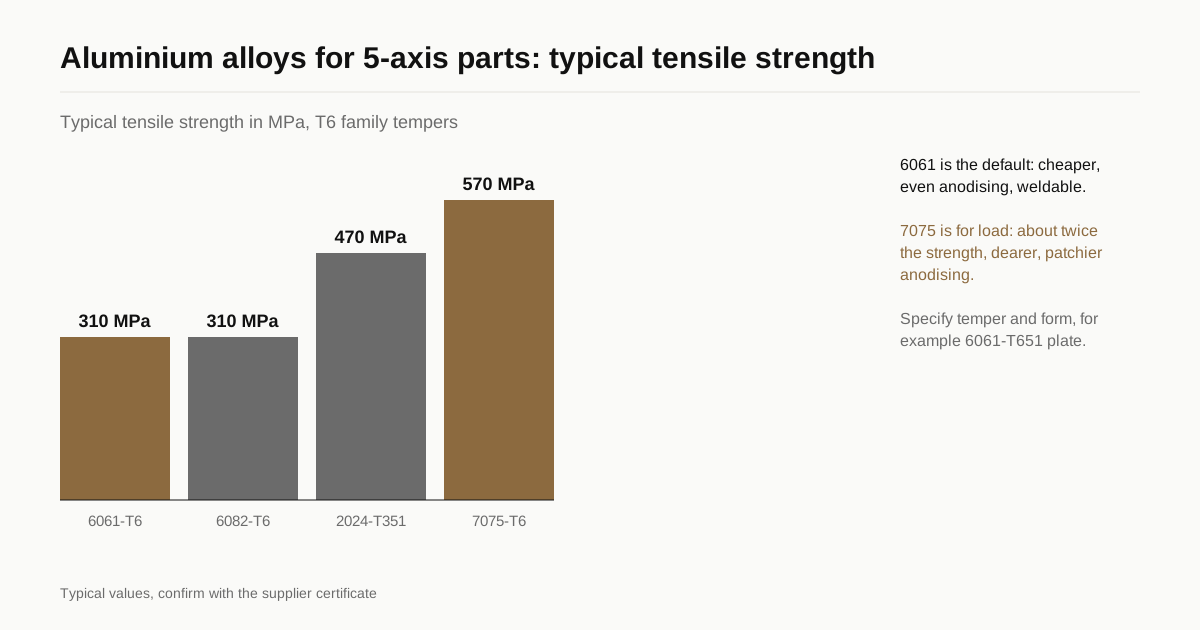
6061 and 7075 side by side
| Property | 6061-T6 | 7075-T6 or T651 |
|---|---|---|
| Typical tensile strength | About 310 MPa | About 570 MPa |
| Typical yield strength | About 275 MPa | About 500 MPa |
| Machinability | Good, easy chip control | Good, harder on tools |
| Anodising | Even, takes colour well | Less uniform, tends darker |
| Welding | Good | Poor, not recommended |
| Corrosion resistance | Good | Lower, sensitive to stress corrosion in some tempers |
| Relative cost | Lower | Higher |
| Typical use | Housings, brackets, fixtures, frames | Structural parts, high-load fittings, tooling |
Choose 6061 unless the load needs 7075. Moving to 7075 for a part that does not need the strength adds cost, anodising risk and lead time for no benefit.
Other alloys that appear
Buyers sometimes name other grades. 6082 is a European alternative to 6061 with similar properties. 2024 is strong but needs surface protection. 5052 and 5083 are common in sheet and marine parts, and are not usually a first choice for machined parts. Cast tooling plate sold under maker names is made for flatness and low stress and is popular for fixtures and plates. If you name an alternative, ask the shop whether it is stocked or imported to order.
Where the stock comes from
Vietnam has a large local aluminium industry, mostly extrusion for construction and consumer goods. Machining-grade 6061 and 7075 plate and bar are available through distributors, and often imported from nearby Asian mills or further away. For you this means three questions.
- Where was the material made? Ask for the mill certificate, not a distributor’s statement. Our guide to mill certificates for parts made in Vietnam covers what the document must show.
- Is the stock in Vietnam or to be ordered? Thick plate, large bars and 7075 in odd tempers often need weeks. Ask for the lead time with the quote.
- Is the form right? Plate, bar, extrusion and forging have different grain flow and residual stress. State the form you need.
If your drawing allows alternatives, say so. A shop that can use a stocked size will quote a shorter lead time.
Temper and stress relief
Temper names the heat treatment. For machined parts, T651 on plate and T6511 on extrusion mean the material was stress relieved by stretching, which reduces the stress that causes distortion. T6 without the stress relief suffix can warp more on thin parts and large pockets.
Put the full designation on the drawing, for example “6061-T651 plate”. Without it the shop will buy what is cheapest to get and stocked.
Preventing distortion on thin parts
Five-axis parts often have thin walls, deep pockets and large open faces. Distortion shows after the part comes off the machine. Common remedies:
- Stress-relieved plate and enough stock to cut the part from inside the plate rather than the surface.
- Balanced removal. Cut both sides of a wall evenly rather than finishing one side first.
- Rough, rest, finish. Rough cut, release the clamps, let the part settle, then finish.
- Soft jaws or custom fixtures that hold without bending.
- Fewer setups. A 5-axis machine can cut features on several sides in one clamping, so less stress builds up through re-clamping. Our guide to tolerances shops hold covers where flatness limits appear.
Ask the shop to describe its approach for your part. A good answer is specific, such as “rough, then 24 hours rest, then finish”.
Anodising and finishing
6061 anodises evenly and is the safe choice where colour matters. 7075 can look darker and patchier, and colour can vary between lots. If a cosmetic result matters, ask for a sample from the exact alloy. For Type III hard anodising, 7075 works but check the thickness allowance on tight features. See finishing for 5-axis parts for coating growth and masking.
Surface and cutting practice
Aluminium machines well, which hides poor practice. Built-up edge on the tool causes smeared surfaces. Sharp polished tools, high speed and a good coolant or air strategy give clean surfaces. Chip packing in deep pockets causes marks. Ask for roughness requirement in Ra and test it on the first article. See first article inspection for what to check.
Cost drivers
- Material form. Thick plate costs more per kilogram than bar.
- Buy-to-fly ratio. A part that removes 90 percent of the block is mostly machining time and swarf.
- Alloy and temper. 7075 costs more than 6061 and wears tools faster.
- Finish. Anodising, bead blasting and masking add steps.
- Tolerance. Tight bands add measuring time and scrap risk.
Typical lead time and stock
Standard 6061 plate and bar in common thicknesses are usually available from distributors within days. Larger sections, thick 7075 plate and unusual tempers can take several weeks, because they are imported to order. A shop that keeps stock of the sizes you use will quote a shorter lead time and a lower material price. If you expect repeat orders, tell the shop the annual quantity so it can buy a full plate or a full bar and cut it economically.
Ask the shop to separate three times on the quote: material lead time, machining time and finishing time. A single total hides where the delay sits, and you cannot compare shops without the split.
Common mistakes
- Naming the alloy and not the temper. 6061-T6 and 6061-O are very different materials in strength and machining behaviour.
- Choosing 7075 for a part that does not carry load. The part costs more and anodises less evenly with no benefit.
- Ignoring the finish when choosing the alloy. If colour matters, test anodising on the alloy before the full run.
- Leaving stock substitution open. A shop may swap 6061 for a similar grade it holds in stock. Say whether that is allowed and what certificate must prove it.
- Over-tolerancing flat faces. Flatness on a large thin part is limited by stress and clamping, not by the machine. Ask what is realistic.
What to put in the RFQ
- Alloy, temper and product form, for example “6061-T651 plate”.
- Material standard to meet (ASTM, EN, JIS) and certificate type.
- Whether stock substitutions are allowed.
- Tolerance, flatness and surface requirements.
- Finish and masking.
- Annual volume, so the shop can plan stock.
Send the drawing with the alloy and temper marked and we will match it to up to three shops that cut this alloy and can show the certificate, with a reply within 24 business hours.
Questions
Which is better for 5-axis parts, 6061 or 7075?
Neither is better in general. 6061-T6 is cheaper, machines well, anodises evenly and welds. 7075-T6 is roughly twice as strong and suits structural parts, but costs more, anodises less evenly and does not weld well. Choose by load and finish, not by habit.
Can I get 7075 plate in Vietnam?
Yes, through importers and distributors, but stock sizes and tempers vary and thick plate often has a lead time. Ask the shop whether it holds the size you need or buys to order, and ask for the mill certificate with the heat or lot number.
What temper should I specify?
For plate, T651 means solution treated, stress relieved by stretching and artificially aged, and is the usual choice for machined parts because it distorts less. For extrusions, T6511 is the equivalent. Name the temper and the product form on the drawing.
Why do thin aluminium parts warp after machining?
Residual stress in the material is released as metal is removed. Stress-relieved plate, balanced material removal, rough-then-finish with a rest between and good fixturing all reduce it. Five-axis setups help because the part is cut from several sides in one clamping.
Have a part rather than a question?
Send the drawing and we match it with up to 3 Vietnam shops that run this kind of work. We reply within 24 business hours.