5-Axis Machining in Vietnam: Shop Classes and Capacity Map
5-axis machining in Vietnam is not one market. It is five classes of shop that look alike on a website and behave differently on a drawing: indexed 3+2 job shops, simultaneous 5-axis job shops, mill-turn shops, mould and die shops and the machining departments of foreign-invested manufacturers. Pick the class from the part first, then the region and the shop. As of October 2026.
5AxisVN is a matching service. We own no machines, we name no shop and we publish no count of shops, because no official count exists that we could open.
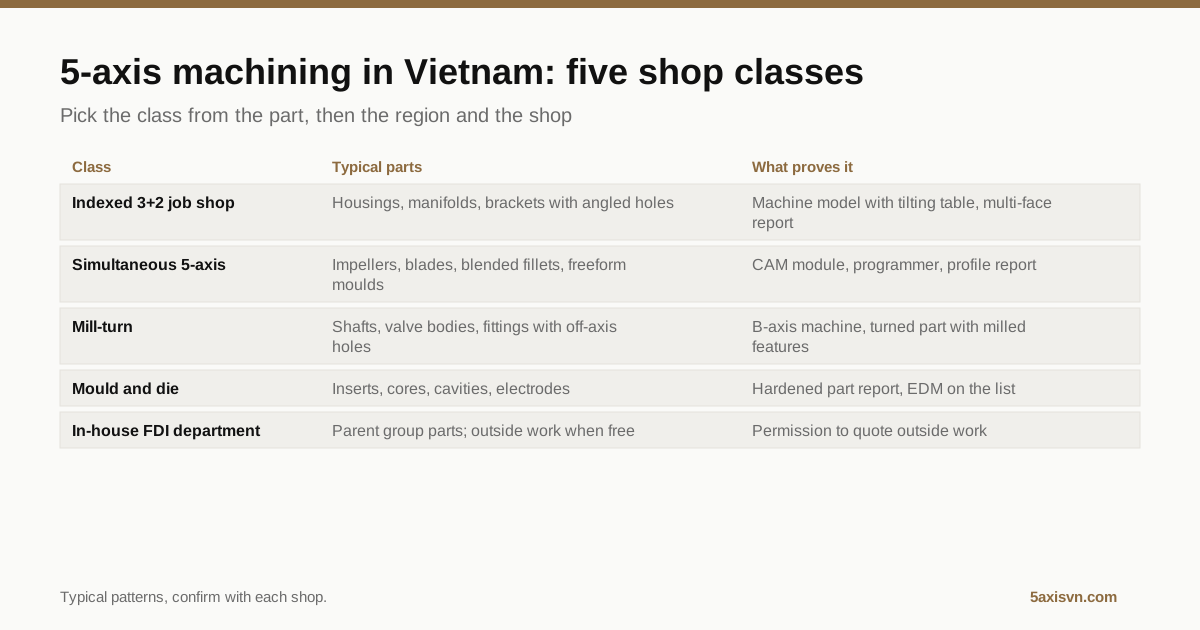
| Class | How the machine is used | Typical parts | What proves the class | Main risk for a buyer |
|---|---|---|---|---|
| Indexed 3+2 job shop | Part tilted to a fixed angle, locked, cut with three axes | Housings, manifolds, brackets with angled holes, fixture plates | Machine model with a tilting rotary table, report from a multi-face part | Quotes “5-axis” for work it will index (fine) or for freeform work it cannot do (not fine) |
| Simultaneous 5-axis job shop | All five axes move during the cut | Impellers, blades, blended fillets, ports, freeform moulds | CAM seat with machine kinematics, a programmer, a report or scan from a freeform part | Few seats and few programmers, so queues and key-person risk |
| Mill-turn shop | Turning centre with a B-axis milling head, part finished in one chucking | Shafts, valve bodies, fittings with off-axis holes | Machine model with B-axis and sub-spindle, a turned part with milled features | Bar size and length limits, cycle time on large parts |
| Mould and die shop | 5-axis hard milling plus EDM and grinding | Mould inserts, cores, cavities, electrodes | Hardened part report, EDM machines on the list, steel certificates | Tool-room habits: one-off quality, slow on repeat batches |
| In-house department of a foreign-invested maker | Machines serve the group’s own products first | Parts for the group’s own products; outside work when capacity is free | Whether it is allowed to quote outside work at all | Your lot waits behind the parent’s orders |
Why the class matters more than “5-axis”
“5-axis” on a shop’s website covers everything from a 3-axis machine with a rotary table bolted on to a trunnion machine running blade toolpaths all day. The two ends of that range quote differently, schedule differently and fail differently.
Simultaneous 5-axis means all axes move while the tool cuts, so the tool stays at the right angle to a surface that changes shape. It is needed for impellers, turbine-type blades, blended fillets and freeform mould surfaces. It needs CAM software that models the whole machine, a post-processor tuned to that machine and a programmer who uses it every week.
3+2 indexed means the part is rotated to an angle, clamped there and cut with three axes, then moved to the next angle. It gives most of the benefit of five axes on prismatic parts: one setup instead of four, so faces relate through the machine and not through re-clamping. For a housing with ports on three angled faces it is usually the right process and the cheaper one.
Most shops that own a 5-axis machine run most of their work as 3+2. That is not a fault. The fault is a quote that does not say which one was assumed. Our 3+2 versus simultaneous guide goes through the difference feature by feature.
Class by class
Indexed 3+2 job shops
The widest class. A typical floor has several 3-axis vertical machining centres, one or two with a tilting rotary table, and sometimes a compact trunnion 5-axis machine. Work is aluminium and stainless housings, brackets and fixtures in batches from a handful to a few hundred.
Good fit: prismatic parts, tolerances in the standard and precision bands of our tolerance reference, batch work. Weak fit: freeform surfaces, thin blades, deep undercuts.
Simultaneous 5-axis job shops
A smaller class. The difference is not only the machine but the CAM seat and the person behind it. These shops often show a sample impeller or blade and can export a CAM simulation screenshot. Ask for a report or a scan deviation map from a freeform part, not a photo.
Good fit: impellers, ports, blended surfaces, aerospace-type thin-wall parts. Weak fit: simple prismatic parts, where you pay simultaneous rates for indexed work.
Mill-turn shops
Turning centres with a milling spindle on a B axis and often a second spindle. A part with a turned body and milled flats, cross holes or angled ports comes off finished in one chucking. These shops often run steel, stainless and brass bar. The part envelope is set by bar capacity and swing, not table size.
Mould and die shops
Tool rooms that run 5-axis hard milling next to wire and sinker EDM and surface grinding. Many serve the plastic injection and die-casting plants of the electronics and automotive supply chains. Good for hardened inserts, cores and graphite or copper electrodes. Repeat production batches are not their habit, so plan inspection for lot two as carefully as for lot one.
In-house departments of foreign-invested makers
Large manufacturers often run their own machining departments. Some quote outside work when capacity is free; many are not allowed to. If one does quote, ask in writing who decides priority when the parent’s orders rise. The FDI versus local comparison covers ownership in more detail.
Ownership cuts across every class
Each class above exists in foreign-invested and in Vietnamese-owned form. Ownership changes the counterpart, the customer mix and often the report format the shop is used to. It does not change whether a machine runs simultaneous work. Check ownership on the National Business Registration Portal with the shop’s legal name and tax code, and judge capability on evidence.
Region: where the classes sit
Vietnam merged its provinces in mid-2025, from 63 provincial-level units to 34. Industrial areas that buyers still know by their old names now sit inside larger units. We use the new names below.
| Region | Provinces and cities (2025 names) | Former names you may still see | Industry mix that drives demand for 5-axis work | Main exit |
|---|---|---|---|---|
| North | Hanoi, Bac Ninh, Hai Phong, Hung Yen, Phu Tho | Bac Giang (now Bac Ninh), Hai Duong (now Hai Phong), Thai Binh (now Hung Yen), Vinh Phuc (now Phu Tho) | Electronics assembly, motorbike and automotive supply, Japanese and Korean supplier parks | Hai Phong port, Noi Bai airport |
| South | Ho Chi Minh City, Dong Nai, Tay Ninh | Binh Duong and Ba Ria-Vung Tau (now Ho Chi Minh City), Long An (now Tay Ninh), Binh Phuoc (now Dong Nai) | Mixed industry, machinery, furniture and consumer goods, a large Japanese and Taiwanese supplier base | Cai Mep and Cat Lai ports, Tan Son Nhat airport |
| Central | Da Nang and neighbours | Quang Nam (now Da Nang) | Smaller base, some automotive and aerospace supply | Da Nang port and airport |
Region tells you the lane and the neighbouring industries. It does not tell you the class. The Hanoi and Ho Chi Minh City guide covers ports, distances and transit.
How to verify the class of one shop
- Machine list with make, model and year. Then look the model up. A trunnion or swivel-head model is a 5-axis machine; a 3-axis model with a rotary table is a 3+2 setup. Our machine brands guide lists the common families.
- CAM system and programmer. Which software, which version, who writes the toolpaths and whether the post-processor was made for the exact machine. See CAM programming in Vietnam shops.
- A report from a comparable part, with the customer removed. For a freeform part, a scan deviation map or a CMM profile report.
- Measurement in-house or outside. A shop that sends every part out cannot correct itself between parts. See inspection labs.
- The trial. One small lot with a first article report before the volume. Our capability check has the 12 questions in order.
What the classes mean for price and lead time
| Class | Cost driver to watch | Lead time driver |
|---|---|---|
| Indexed 3+2 | Number of tilts and setups, fixture design | Machine queue, material from stock |
| Simultaneous 5-axis | Programming hours, cycle time on the surface, tool wear | Programmer availability, prove-out |
| Mill-turn | Bar size, cycle time | Bar delivery, setup slot |
| Mould and die | Hard milling and EDM hours, steel and heat treatment | Heat treatment subcontract |
| In-house department | Spare-capacity pricing that can change | Parent’s schedule |
We publish no rates. For a country comparison, see Vietnam versus China, Thailand and Mexico.
Using this map in an RFQ
Write the class you expect, or say you do not know and want advice. Mark which features need simultaneous motion and which can be indexed. Give material, certificate type, quantity breaks and the Incoterm. Send the drawing and we match it to up to three shops in the right class, with a reply within 24 business hours.
Frequently asked questions
How many 5-axis machine shops are there in Vietnam?
No official count exists that we could open. Business registers list companies by business line, not by machine type, and directories that publish a number do not say how they counted. Treat any figure you see as marketing. Sort shops by class and check each one on its own evidence.
Which class should I send my part to?
Start from the part. Prismatic parts with features on several angled faces usually belong with an indexed 3+2 shop. Freeform surfaces, blades and blended fillets need a simultaneous 5-axis shop. Shafts with off-axis features suit a mill-turn shop, and hardened mould inserts suit a mould shop with hard milling and EDM.
Is the north or the south of Vietnam better for 5-axis work?
Neither is better as a rule. Both regions have shops in every class. The region mainly changes which port and airport your parts leave from and which industries the shop already serves. Compare quotes from shops in the right class, then check the lane.
Does a 5-axis machine on the shop floor mean the shop runs simultaneous work?
No. Many machines that can move five axes together are used for 3+2 indexed work only, because the shop has no CAM seat or programmer for simultaneous toolpaths. Ask for the CAM system, the programmer and a report from a simultaneous part.
Sources
- Vietnam Briefing: Vietnam's provincial mergers, consolidation from 63 to 34 provinces and cities
- Quan Doi Nhan Dan: Vietnam unveils administrative overhaul reducing provincial-level units from 63 to 34
- National Business Registration Portal of Vietnam
Standards and rules are cited as references, not as claims about 5AxisVN or any shop. Confirm the edition and current status with the issuing body.
Have a drawing?
Send it with the material, quantity and the features that matter. We pass it to up to 3 shops and reply within 24 business hours.