Copper and Brass on 5-Axis Machines in Vietnam: Electrodes, Busbar Blocks and Fittings
Copper and brass sit in a different corner of the 5-axis market from steel and titanium. They are soft, they cut fast, they conduct heat and electricity and they are expensive by the kilogram. Typical 5-axis jobs are EDM electrodes, busbar blocks, connector bodies, waveguide parts and brass fittings.
We are a matching service. We own no machines and name no shop. Figures are typical and your drawing and material standard take priority.
The alloys
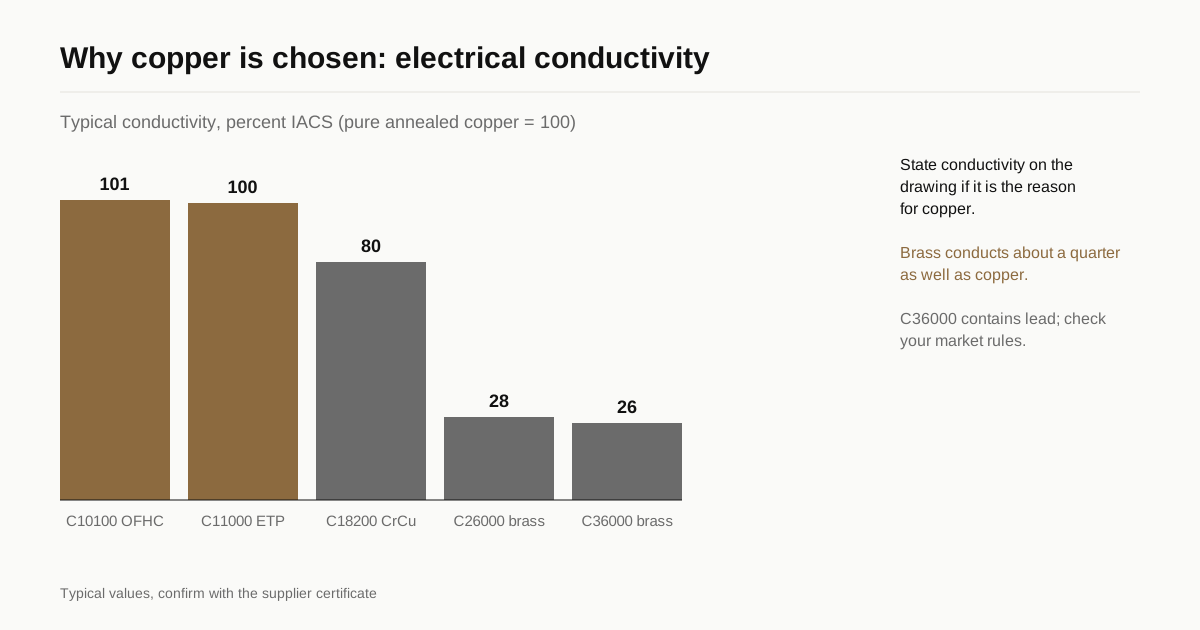
| Alloy | Designation | Typical conductivity | Typical use |
|---|---|---|---|
| Oxygen-free copper | C10100 | About 101 percent IACS | Vacuum parts, high-purity conductors |
| Electrolytic tough pitch copper | C11000 | About 100 percent IACS | Busbars, electrodes, heat sinks |
| Chromium copper | C18200 | About 80 percent IACS | Welding electrodes, mould inserts, contacts |
| Free-cutting brass | C36000 | About 26 percent IACS | Fittings, connectors, turned and milled parts |
| Cartridge brass | C26000 | About 28 percent IACS | Formed and deep-drawn parts |
IACS means percent of the International Annealed Copper Standard, with pure annealed copper at 100. Conductivity is the reason copper is chosen, so a drawing that needs it should state the value and the test.
Electrodes for EDM
Copper and graphite are the two usual electrode materials for sinker EDM. Copper gives a good surface finish and lasts well in fine detail, but is soft and can bend or burr in thin features. Graphite machines faster and is common in volume work. A 5-axis machine can cut electrodes with tilted features and undercuts in one clamping, which matters because the electrode shape has to match the cavity it will erode.
Practical points for electrode jobs:
- Burr control. Burrs on an electrode transfer into the cavity, so edges must be clean.
- Thin ribs. Copper bends under cutting force, so tool paths with light cuts are needed.
- Fixturing. A reference system that carries over to the EDM machine, such as a common holder, saves setup time.
- Quantity. Electrodes are often needed in sets, from roughing to finishing, with a small clearance difference between them.
Electrode size sets cavity size, so read our guide to tolerances shops hold before you set the band on an electrode drawing.
Busbars and conductive blocks
Flat busbars are usually cut, punched and bent on dedicated equipment. The 5-axis machine takes over when a busbar has complex shape: machined blocks, connection bodies with angled bores, thick copper heat spreaders and housings. Key points:
- Conductivity. Check that the certificate states conductivity or the alloy and temper.
- Flatness. Contact faces carry current, so flatness and surface finish matter.
- Burrs. A burr at a contact face raises resistance and damages mating parts.
- Plating. Tin, silver and nickel plating protect against oxidation and keep contact resistance low. State the thickness and the dimensions that apply after plating, as in our guide to finishing 5-axis parts.
Machining behaviour
Pure copper is gummy. It smears, builds up on the cutting edge and leaves long chips. Sharp tools with high rake angles, polished flutes and good coolant give clean surfaces. Slow feeds cause rubbing. Chip control is the hard part, and deburring is a normal step in the job.
Free-cutting brass is the opposite. It cuts fast and breaks chips well, and produces good surfaces. Its lead content is what makes it easy to machine, which leads to the restriction question below.
Chromium copper is stronger and harder, so tools wear faster than in pure copper. It is often aged after machining, so ask whether the ageing condition is required.
Lead and restricted substances
C36000 brass contains lead. Some markets restrict lead in certain parts, such as water contact, consumer products and some electronics categories. If your parts fall under such rules, say so in the RFQ and ask for a lead-free brass or another alloy. Rules change, so confirm the current position with your compliance team.
Material sourcing and certificates
Copper and brass rod, bar and plate are available in Vietnam through distributors, with many items imported. Copper is expensive and traded by weight, so ask for the weight of the blank and what scrap is returned. Certificates should state the alloy designation, temper and, for conductive parts, conductivity. See our guide to mill certificates for the checks. Material substitution, such as brass supplied in place of copper, is easy to do and hard to see by eye, so positive material identification is useful.
Surface and packing
Copper tarnishes, and fingerprints stain it. Parts should be cleaned after machining, wrapped in sulphur-free paper or VCI material suitable for yellow metals, and sealed with desiccant. Our guide to export packing lists the layers. Ask the shop what it uses on copper, since steel-grade VCI wrap can stain it.
Cost drivers and scrap
Copper is expensive and sold by weight, so the cost of a copper part depends heavily on how much metal is cut away. A part machined from a solid block may turn most of the blank into chips. Ask the shop three things:
- Whether the chips and offcuts are credited back to you or kept by the shop.
- Whether the blank can be a near-net shape, such as a drawn or extruded section close to the final profile.
- How much extra material the shop proposes for the first article and scrap.
On a recurring job, a correctly sized blank can save more than a lower machining rate. On electrodes, the cost is dominated by the number of pieces in the set and the time to finish the fine detail.
Common mistakes
- Writing “copper” without a designation. The shop will quote the cheapest alloy that fits the words.
- Forgetting that brass contains lead. If your market restricts lead, name the requirement before the order.
- Skipping the burr specification. A burr on a contact face or an electrode edge is a functional defect.
- Plating without a post-plating dimension. Plating adds thickness that can close a fit.
- Packing in the wrong wrap. Paper or film with sulphur compounds can tarnish copper. Ask for material suited to yellow metals.
Inspection points for copper parts
Soft metal shows damage easily, so inspection covers more than dimensions. Check contact faces for flatness and scratches, edges for burrs under magnification, plating thickness on contact surfaces and the part weight against the drawing mass, which can reveal a wrong alloy. For conductive parts, ask whether the shop measures conductivity on the stock or relies on the certificate, and agree how a dispute would be settled.
What to put in the RFQ
- Alloy by UNS designation and temper, and the conductivity requirement if any.
- Burr and edge-break requirement, especially on contact faces and electrodes.
- Plating or coating, thickness and which dimensions apply after.
- Lead content requirement, if any.
- Packing method and cleanliness.
- Sets and spares for electrodes.
Send the drawing with the alloy and conductivity needs and we will match it to up to three shops that cut copper and brass, with a reply within 24 business hours.
Questions
Which copper grade should I name?
Name the UNS or EN designation and the property that matters. C11000 (ETP copper) is the common conductive grade. C10100 is oxygen-free copper for vacuum and high-purity work. C18200 chromium copper gives higher strength and hardness with lower conductivity. Asking for 'copper' alone leaves the shop to choose.
Why is copper hard to machine?
Pure copper is soft and gummy. It smears under the tool, forms long chips, leaves burrs and can work-harden slightly. Sharp tools with high rake, good chip control and a plan for deburring give clean results. Brass, by contrast, cuts freely.
Do I need to worry about lead in brass?
Free-cutting brass such as C36000 contains lead for machinability. Some markets and applications restrict lead content, for example in drinking water parts or certain electronics rules. State your requirement and ask for a lead-free alternative if needed. Confirm current rules with your compliance team.
Can a shop plate or coat copper parts?
Yes. Tin, silver and nickel plating are common on busbars and contacts. Most shops outsource plating, so ask who does it, what thickness you need and which dimensions apply after plating.
Have a part rather than a question?
Send the drawing and we match it with up to 3 Vietnam shops that run this kind of work. We reply within 24 business hours.